
DCHS x Language World Interpreter Pilot Program Results: Language Access Leads to Better Outcomes
The Medical Interpreter Pilot Project (MIPP) was created some 10 years ago by Assembly Bill (AB) 635, authored by Toni Atkins, a former Democratic California State Senator from San Diego. The legislation mandated the California Department of Health Care Services (DHCS) to evaluate measurable ways for improving medical interpreting for Medi-Cal beneficiaries with Limited English Proficiency (LEP). As a key partner in this study, Language World earned the privilege of providing critical onsite interpreter resources at the Los Angeles County pilot site in Culver City at a large multi-practice Federally Qualified Health Center.
By staffing these face-to-face professional interpreting encounters, Language World directly addressed the unique communication needs of a highly diverse patient population, proving that on-site professional interpreters really do reduce health disparities and improve the quality of care.
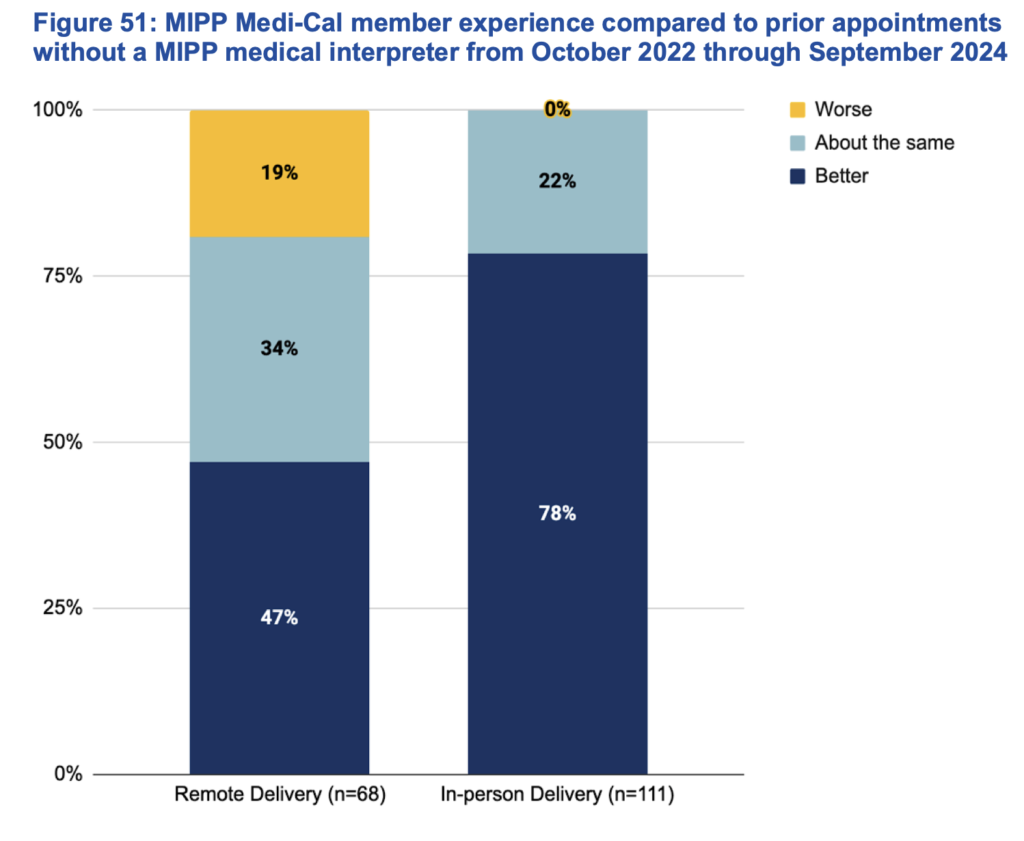
Key Findings:
In‑person interpreting leads to much higher reported improvement. 78% of in‑person users said the experience was better.
Remote interpreting still improves experiences.
Remote Delivery:
- 47% Better
- 34% About the same
In‑person interpreting had 0% reporting a worse experience.
For the many LEP patients served, these interventions led to improved health outcomes, including higher levels of patient trust, more accurate clinical comprehension of treatment plans and a notable reduction in 30-day hospital readmission rates compared to those without access to qualified medical interpreting. The findings, analysis and significance of this landmark study was prepared for DHCS by the University of California Berkeley School of Public Health.
Findings indicate that in-person interpreting yields significantly higher patient satisfaction and no reported negative experiences compared to remote delivery;
therefore,
facilities serving threshold language populations should prioritize in-house, staff-integrated in-person interpreters to ensure consistent, high-quality, and equitable communication access.
Read full results here.